Chapter 5 - Borrowed Flowers
Chapter 5: Borrowed Flowers
As If You Never Left
The morning came softly, with sunlight warming the curtains and bathing the walls in gentle gold. Elara stood on Mira’s balcony, barefoot, a pair of garden shears in her hand and dew still clinging to her lashes.
Mira’s plants had begun to wilt in the weeks after the funeral. The jasmine had browned at the edges, the marigolds drooped. Neglect had turned what was once a blooming corner into a garden of grief. But today, Elara worked with quiet hands, pruning what was dead, trimming what could be saved.
She didn’t know what compelled her to tend to the flowers. Maybe it was instinct. Maybe it was guilt. Or maybe it was the memory of her mother’s voice, years ago, teaching her how to clip a stem at just the right angle so it wouldn’t die alone.
She moved with care, rearranging pots and pulling weeds, her fingertips streaked with soil. And as she worked, she hummed. Not Mira’s songs, not the playlists Raiyan had mentioned. Her own—soft, wordless melodies that had followed her from the life before.
When she stood back to look at the transformed balcony, it felt like breathing again. Not resurrection. Not healing. Just the quiet reclaiming of space.
She plucked a single bloom and brought it inside, placing it in a vase by the window. A small offering. Something living.
And just as she turned to rinse her hands, she heard the gentle knock at the door.
Raiyan.
She froze, one hand still damp from the tap.
She wasn’t expecting him.
Her heart skipped—not with fear, but with something quieter. Something more complicated. The memory of the night in the wedding dress still lived in her, vivid and aching. His hands around her waist, the music, the imagined chandelier. The silence after.
She hadn’t seen him since.
She’d kept her distance on purpose, unsure of what that night had meant. Unsure of what it had done to the fragile boundary she had drawn between herself and the life she was borrowing.
And now he was here. Again.
She dried her hands slowly, as if buying time might soften the edge of whatever came next.
Be still, she told her heart. Don’t want too much.
She opened the door.
Raiyan stood there with a box in his hands, wrapped in simple brown paper and tied with twine. He looked freshly showered, but the edge of sleep still lingered beneath his eyes.
“Hey,” he said softly, almost cautiously.
Elara managed a small smile. “Hi.”
“I, uh… saw these at the market,” he continued, lifting the box slightly. “Thought you might like them. For the balcony.”
She stepped aside without a word and let him in.
He moved quietly, as though afraid to disrupt whatever peace she had found that morning. When she placed the box on the table and peeled it open, her breath caught.
Inside were sprigs of rosemary, fresh mint, and a few lavender cuttings—small potted herbs with tender roots and the scent of something simple. Something kind.
“I didn’t know if you’d want flowers again,” he said. “But these felt… alive. Like they’d stay.”
Elara touched the edge of the rosemary pot with her fingertips.
“They’re perfect,” she said, voice barely above a whisper.
They stood there, not quite meeting each other’s eyes, surrounded by soil and silence and all the things they didn’t yet know how to say.
Raiyan cleared his throat softly. “You’ve been taking care of them. The balcony. It looks… alive again.”
Elara nodded, brushing a thumb over the mint leaves. “It felt like something I could do. Something real.”
He leaned against the counter, arms folded, watching her. “You used to say that too. That growing things helped quiet your thoughts.”
Elara blinked, a small wrinkle forming between her brows. “Did I?”
“You did.” He smiled faintly. “Usually after overwatering them.”
She gave a quiet laugh, but it didn’t quite reach her eyes. “Maybe I’m learning.”
He studied her for a moment, the way her hair fell into her face, the way her fingers curled gently around the edge of the table.
“I’ve missed this,” he said, so softly she almost didn’t catch it.
Elara looked up. “What do you mean?”
“This,” he gestured vaguely—around the kitchen, toward the window. “You. Here. Being… you.”
Her smile faltered.
For a moment, neither of them said a word. The silence thickened, stretched.
Then Elara turned back to the herbs, gently rearranging them. “Some parts of me are still finding their way back.”
Raiyan nodded slowly. “Take all the time you need. I’m not in a rush.”
But the truth neither of them could say was that time was exactly what she didn’t have.
Elara sat down at the table, motioning for him to do the same. The light streaming through the window settled between them like a quiet third presence.
“Have you been sleeping well?” she asked, mostly to fill the silence.
Raiyan shrugged. “Sometimes. I wake up thinking you’re not here again. That it was all just… a long dream.”
She looked down, hands folding around the clay pot of lavender. “And when you realize I am?”
He didn’t answer immediately. “I don’t know. Relieved. Scared. Like I’m being given something I don’t deserve.”
She met his gaze, and for once, didn’t look away.
“Maybe it’s not about deserving,” she said.
He nodded, slowly, his eyes still on her. “Maybe it’s just about not wasting it.”
Elara exhaled quietly, a breath she hadn’t realized she’d been holding.
And then she said something she hadn’t planned to. Something small, but honest:
“I think about the end sometimes. What it’ll mean. What it’ll feel like.”
Raiyan’s face shifted, barely perceptibly. “Why would you think about that now?”
She paused, choosing her words with care. “Because I want to know how to make every moment count.”
He reached across the table and gently covered her hand with his.
“Then let’s count them. Together.”
Elara held still, absorbing the warmth of his hand over hers, the scent of rosemary and mint rising between them.
And in that quiet, she let herself believe—for just a moment—that maybe they could.
Raiyan didn’t let go of her hand right away.
His thumb traced a slow, absent circle over her knuckle, and she didn’t pull away. She watched the light shift across the table, dappling the rim of her teacup, catching the fine hairs on his forearm, making the whole moment feel oddly suspended.
“Do you remember,” he said after a while, “how you used to tuck little sprigs of lavender in my bag before I left for work?”
Elara blinked. She didn’t. But she nodded softly, letting him continue.
“I’d find them hours later,” he said, smiling faintly. “Always a bit crushed, but the scent would stay. Like you were reminding me to breathe.”
She looked down at the lavender between them. “Maybe you needed that more than I thought.”
“Maybe I still do.”
She wanted to say so many things—about memory, about identity, about the ache of wearing someone else’s tenderness—but the words stayed lodged in her throat.
So instead, she leaned forward, just slightly. Not enough to close the distance completely, but enough to show she was listening. That she remembered, too, in her own way.
And there, in the warmth of the morning and the scent of borrowed herbs, they stayed a while longer.
Two people, sitting in the soft pause between past and present. Between what was lost and what might still be found.
At some point, she began to hum again. A gentle, almost wistful melody—something wordless, woven from a place neither Mira nor Raiyan had ever touched.
Raiyan didn’t recognize the tune. It wasn’t from Mira’s playlists, nor the old folk songs she used to hum while baking or folding laundry.
He looked at her, puzzled for half a breath.
But then he told himself it didn’t matter. People changed. Traumas reshaped them. Maybe this was part of her healing—new rhythms, new thoughts, songs that had bloomed in the quiet between who she was and who she was becoming.
So he let it be.
He closed his eyes and listened, letting the unfamiliar tune wrap around them like light filtered through leaves.
And though something deep inside stirred—something uncertain—he said nothing.
Because she was here.
And that was enough.
Still, the tune lingered in his mind.
Long after they had fallen into a gentle silence, Raiyan found himself hearing it again, like an echo threading through memory. It was beautiful—delicate, unlike anything he could recall Mira ever humming. And yet, it had carried a strange comfort. A sadness wrapped in gentleness.
He opened his eyes and watched her—her profile outlined in the soft wash of morning light, her fingers still trailing patterns in the condensation on the herb pot, her lips barely parted as the melody continued without conscious thought.
It felt like watching something sacred.
He didn’t say it out loud, but part of him wondered. Just briefly. A flicker of something he couldn’t name.
But then she looked up and smiled—genuinely, like the sun had passed through her—and the thought vanished like breath on a mirror.
She was here. She had come back to him.
That was the story he chose.
And he wasn’t ready to question it.
The next day, the doorbell rang just before noon.
Elara wiped her hands on a towel—she had been tending to the herb pots again, rearranging them beneath the sunlight. When she opened the door, a familiar figure stood waiting, dressed in soft pastels and holding a small tin of homemade kuih.
Grandmother Suraya.
The older woman stepped inside without needing invitation, her movements gentle but purposeful, as though she had done this many times before. Her eyes swept the apartment quietly—the vase of freshly cut flowers, the warm scent of mint and rosemary in the air, the way sunlight dappled across the floor.
Elara offered a smile. “Nenek. It’s good to see you.”
Suraya returned it, faintly. “I brought kuih. You always said my seri muka reminded you of your childhood.”
Elara hesitated, then nodded, accepting the tin with both hands. “Thank you.”
They sat in the living room. No music played. No TV hummed in the background. Just the sound of tea being poured and two hearts trying not to break the quiet too soon.
Grandmother Suraya sipped, her gaze soft but searching. “You’ve been… different lately.”
Elara looked down at her cup. “Different how?”
Suraya didn’t answer right away. She reached for a piece of kuih, then paused.
“Not in a bad way,” she said. “Just… gentler. Slower. Like you’re remembering the world for the first time.”
Elara’s breath hitched—so small, it might’ve gone unnoticed.
But not to Suraya.
Not to the woman who had raised Mira alongside her mother.
The grandmother who remembered every tilt of her granddaughter’s head, every cadence of her voice.
And this voice, this posture, this careful silence—it was familiar. But not the same.
Suraya placed her teacup down with care. Her fingers lingered on the rim, the way one might hold on to something delicate before letting it go.
“You used to hum while cooking,” she said quietly. “Usually something loud. Joyful. But yesterday, Raiyan mentioned you’ve taken to humming something else. Softer.”
Elara’s spine tensed.
“I suppose people change,” she offered, her voice steady but hollow.
“They do,” Suraya nodded slowly. “But some changes feel like shadows. Like a different light is casting them.”
Elara didn’t respond. She focused on folding the napkin in her lap, again and again.
“I’m not accusing,” Suraya added gently. “I just… I knew every silence Mira kept. This one doesn’t feel like hers.”
Silence stretched between them, tender and taut.
Finally, Elara looked up. Her voice was softer than before, almost a whisper.
“Do you miss her?”
Suraya’s eyes shimmered, but she smiled. “Every day. But I’m grateful for what’s here now. Even if I don’t fully understand it.”
The older woman reached across and gently rested her palm over Elara’s hand—just for a moment. “Whatever you are, sayang, you’re still someone worth loving.”
Elara’s throat trembled. The napkin in her lap crumpled in her grip.
“I need to tell you something,” she said, voice barely more than a breath.
Suraya paused.
“I’m not Mira. Not fully. Not… really.”
The words hung there, like mist refusing to lift.
Elara’s eyes brimmed with tears, her hands clutching her chest as if trying to hold something inside from breaking free.
“I don’t know why I’m here, or how. I just woke up in this body. And people looked at me like I was her. And so I tried—I’ve been trying—but I’m not. I’m Elara.”
Tears fell, one by one. “I never meant to take her place.”
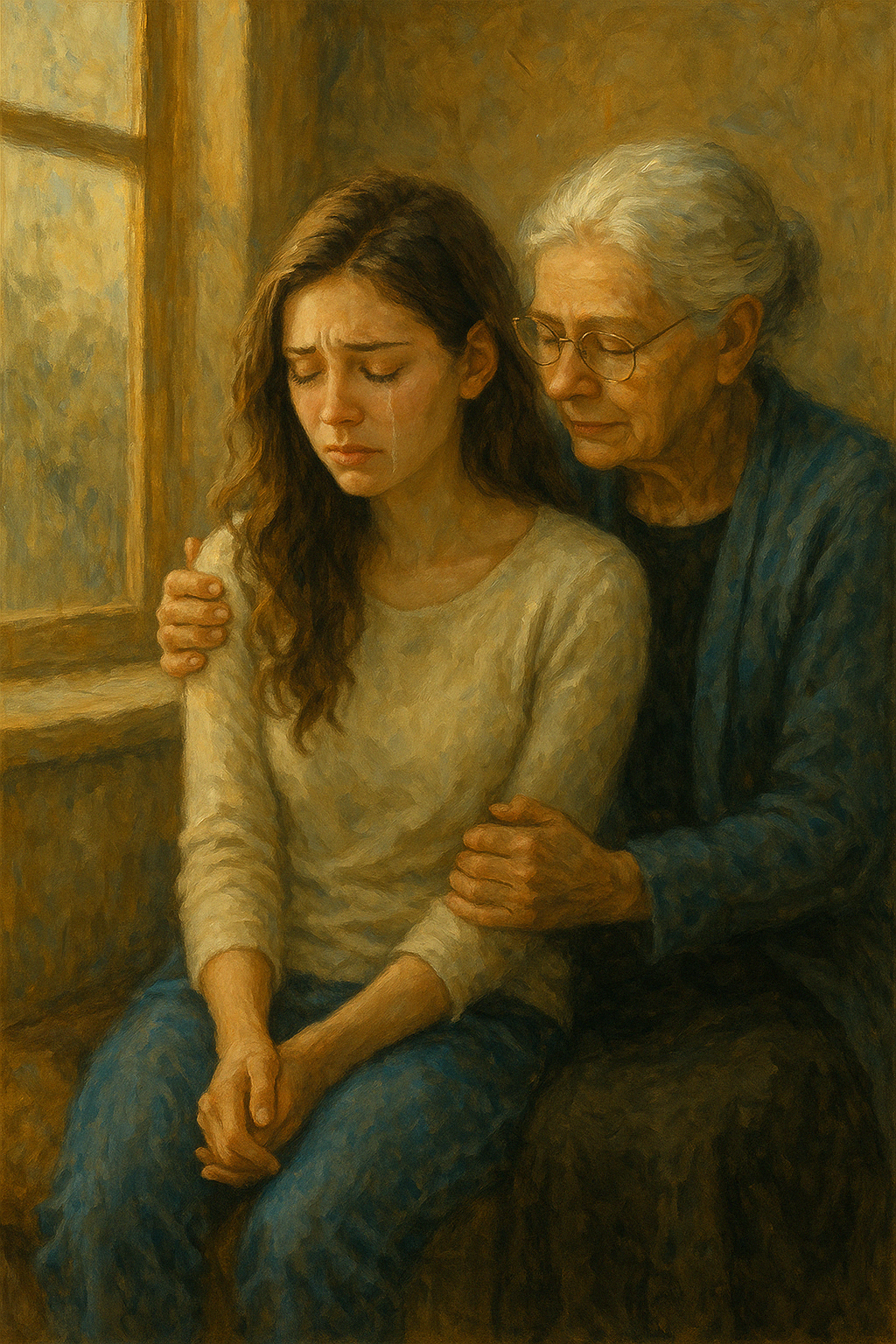
Suraya didn’t speak. She didn’t flinch. She simply reached out and pulled Elara into a quiet, steady embrace.
“My granddaughter is gone,” she whispered, her voice breaking like old wood. “I knew it the moment you looked at me and hesitated. But the girl before me now? She carries her scent. Her quiet. Her grace. Maybe not her name, but something of her heart.”
Elara sobbed harder. She couldn’t remember the last time she had cried like this—open, helpless, known.
Suraya held her until the shaking softened, her hand gently stroking the back of her head.
“You are not Mira,” she murmured. “But I think… you are something just as precious.”
When they finally parted, the space between them felt changed—not fractured, but woven.
Not an ending.
But a quiet beginning.
Elara stood in the quiet apartment long after Grandmother Suraya had gone.
She hadn’t moved from the doorway. Her fingers still tingled from the warmth of the old woman’s parting touch.
It wasn’t suspicion she had felt in that touch. Nor was it confusion or fear. It was love—tempered by grief, and threaded with acceptance. Suraya had heard the truth, and she had embraced it without flinching. Not because she didn’t miss her granddaughter, but because she chose to honour what remained: a girl who carried Mira’s softness, Mira’s silence, and a quiet soul of her own.
Elara walked slowly to the kitchen, the tin of kuih still untouched. She placed it gently on the counter, then sat at the table with her hands in her lap, unsure what to do with herself.
She had tried so hard to move through this borrowed life with care, to tiptoe around the edges of Mira’s memory.
But now—now the lines were blurring faster than she could trace them.
She wasn’t sure which parts were Mira’s anymore.
And which parts were hers.
She rose, finally, and walked back toward the balcony. The afternoon sun was spilling across the potted herbs, the lavender swaying gently in the breeze. She reached down, touched the soil.
Still damp. Still living.
Her reflection in the window caught her off guard. It was Mira’s outline. But the posture—the quiet hesitation in the eyes—that was hers. Elara’s.
She placed a fresh sprig of mint into a glass of water and sat again by the window, breathing in the scent. The ache was still there. But so was something else.
She opened the journal she kept tucked inside Mira’s bookshelf. It was Mira’s, but the entries were hers now.
She wrote:
Day 26.
Today, I stopped pretending I was Mira. And someone still chose to stay.
Maybe this isn’t about becoming her.
Maybe it’s about becoming whole.
She closed the journal and leaned back in the chair, the soft creak of wood settling beneath her weight. Outside, the sky had begun its slow descent into evening, casting long amber streaks across the floor.
The herbs on the balcony shimmered in the golden light. Somewhere in the distance, the muffled call to prayer echoed—low, solemn, comforting.
She let her eyes close.
This time, the silence didn’t feel like absence.
It felt like grace.
She didn’t know how many days were left. She didn’t want to count them. For now, this evening was enough.
The tea had gone cold.
The lavender had begun to bloom again.
And in a body that wasn’t hers, a heart that didn’t belong had learned—gently, tentatively—how to beat again.
Outside, the wind shifted.
And inside, Elara remained still, held by the quiet knowledge that she had not taken Mira’s place.
She had only walked with her, for a little while.
And perhaps, that was enough.