Chapter 3 - Who is Elara
Chapter 3: Who is Elara
As If You Never Left
Elara woke with the light bleeding softly through Mira’s curtains—pale and familiar, yet distant. She stayed still, breathing in the silence, grounding herself in the dull ache that had settled between her ribs.
It was always worse in the mornings. That strange, liminal space between sleep and waking, where for a fleeting second, she forgot whose life she was wearing.
She rose slowly, her feet brushing the cold wooden floor. The mirror above the vanity caught her reflection—Mira’s reflection. She stared.
The woman in the glass had delicate features, the kind people called timeless. Hair falling loosely around her shoulders. Eyes framed with gentle darkness, as though grief had drawn a permanent shadow around them. But Elara could still see traces of herself beneath the skin—tiny things no one else would ever notice. The way she stood slightly off-balance. The rhythm of her breathing. The tension in her jaw when she was lost in thought.
She walked to the dresser and opened the top drawer. Inside were Mira’s notebooks—filled with neat, slanted writing, grocery lists, half-written poems, pressed flowers. Elara turned the pages carefully, a quiet reverence growing in her chest. This woman had loved deeply. Had lived deliberately.
And now Elara had been asked—no, placed—in the center of that life.
She didn’t know how or why. The voice in her memory hadn’t explained. Just those four words: “You have a hundred days.”
No context. No instruction.
Just time. And a body that didn’t belong to her.
She stood by the window, looking down at the street below. Raiyan’s world. Mira’s world. Her temporary home. Somewhere out there, people were grieving a woman who had returned without explanation. Somewhere out there, a man was loving her with the faith of someone who’d waited too long for a miracle.
And she was starting to feel the pull.
Of his kindness.
Of his presence.
Of the ache in his voice when he said her name.
She closed her eyes and pressed her hand to her heart. It beat quietly beneath her ribs—borrowed, yes. But steady. Alive.
“I’m not her,” she whispered to the morning light. “But I’m here.”
She let her eyes close, and more fragments came. Not as dreams, but as sensations that lived in her skin.
The scratch of parchment beneath her fingers as she wrote notes to herself in her tiny flat above the flower shop. The scent of rosemary and citrus she used to rub on her wrists. The gentle lull of violin music that spilled from the café downstairs, a melody she knew by heart though she could never name the song.
And then—Ezra.
His name flickered across her mind like a match struck in a dark room. A man with soft laughter and warm eyes. A friend. A love. Someone she had left behind in that other life, whose voice had faded as she slipped into silence.
She didn’t remember how it ended.
Only that it did.
A sharp pain pulsed at her temples. She pressed her fingers to them, trying to stay anchored.
She was not Mira. She was Elara. A florist. A daughter. A woman who had once dreamt of growing old surrounded by petals and morning sunlight.
And yet, fate—or whatever force had bent time to bring her here—had pressed pause on that story. Handed her this one.
She didn’t know if she was meant to honor Mira’s memory, or simply give closure to Raiyan. But with every passing hour, the weight of the days ahead settled heavier in her chest.
She turned from the window and looked back at the room.
“I’ll make it count,” she whispered. “Even if no one remembers me when I’m gone.”
She moved through the apartment slowly, touching things not as an owner, but as a guest in someone else’s story. A teacup with a faint chip on the rim. A scarf still hanging on the door hook, its ends frayed with love. A stack of letters on the sideboard, some unopened, addressed to Mira in looping cursive.
Everything felt borrowed.
Even the silence.
She found herself in the kitchen next, fingers tracing the rim of a half-used jar of honey. She had always liked honey—real, thick, raw. But she didn’t know if Mira had. The disconnect between what she remembered and what this body remembered was growing starker.
She poured water into a kettle, lit the stove, and sat on the floor as it boiled. That’s when the tears came—quiet, uncertain at first. She didn’t sob. Didn’t shatter. Just… leaked.
They slid down her cheeks and dropped onto the tiled floor like petals falling from a bouquet long past its bloom.
She wasn’t grieving Mira.
She was grieving herself.
Grieving the years she would never return to. The people who wouldn’t know where she’d gone. The unfinished conversations. The mundane, beautiful rituals of a life that had ended too soon.
But now, for reasons she still didn’t understand, she was here.
Not to reclaim.
But to release.
The kettle whistled. She stood and poured a cup of tea she didn’t recognize, in a home that wasn’t hers, with hands that still trembled from a life that no longer existed.
And for the first time, she allowed herself to wonder:
Could you fall in love again—with someone you were never meant to meet?
And if you did…
Was it betrayal?
Or grace?
She took a sip of the tea—too sweet—and set the cup down gently as if afraid to disturb the quiet. Her gaze drifted to the window again, where sunlight now poured in softer through the clouds, breaking apart the grey like fingers parting fabric. There was beauty here, even in the grief. Even in the confusion.
She imagined walking through Mira’s garden—the one she saw in a photo tucked between the pages of a journal. Rows of jasmine, bougainvillea in bloom, and a weathered wooden bench beneath a mango tree. Elara had never stepped foot in that garden, yet somehow, she could smell the earth.
Maybe that was part of this strange return. The bleeding of two lives into one.
She wanted to plant something.
Something small. Something hers. A single marigold, maybe. Not to replace Mira, but to mark her own days. Proof that she had once existed here, however briefly.
As she reached for a pen to scribble the thought down, her hand hesitated over the paper. Her handwriting was different now—Mira’s fingers, Mira’s script. The words were hers, but the form betrayed her.
Still, she wrote:
“Day 7. I miss my hands.”
She stared at it. Let the ink dry.
And then, in a smaller scrawl underneath:
“But maybe I’ll learn how to love with these ones too.”
She folded the note carefully and placed it inside the journal, between two dried petals Mira must have pressed long ago. One was lavender, the other marigold—faded, brittle, but still holding color. It felt right, somehow. A quiet exchange. A shared space.
The doorbell rang.
The sound startled her more than it should have. Her breath caught in her throat. For a brief second, she imagined it might be Ezra—ridiculous, impossible, but grief played tricks like that.
She padded softly to the door and opened it.
Raiyan stood on the other side, holding a small paper bag from the bakery around the corner. His hair was damp, as if he’d walked part of the way in the rain.
“I wasn’t sure if you’d eaten,” he said, voice tentative. “There’s that almond croissant you used to like.”
Elara didn’t correct him. She stepped aside and let him in.
He walked into the kitchen and placed the bag gently on the table. The space felt smaller with him in it. Warmer, too. Not uncomfortable, but tangible—like the gravity of a star pulling everything quietly inward.
“Can I sit?” he asked.
She nodded.
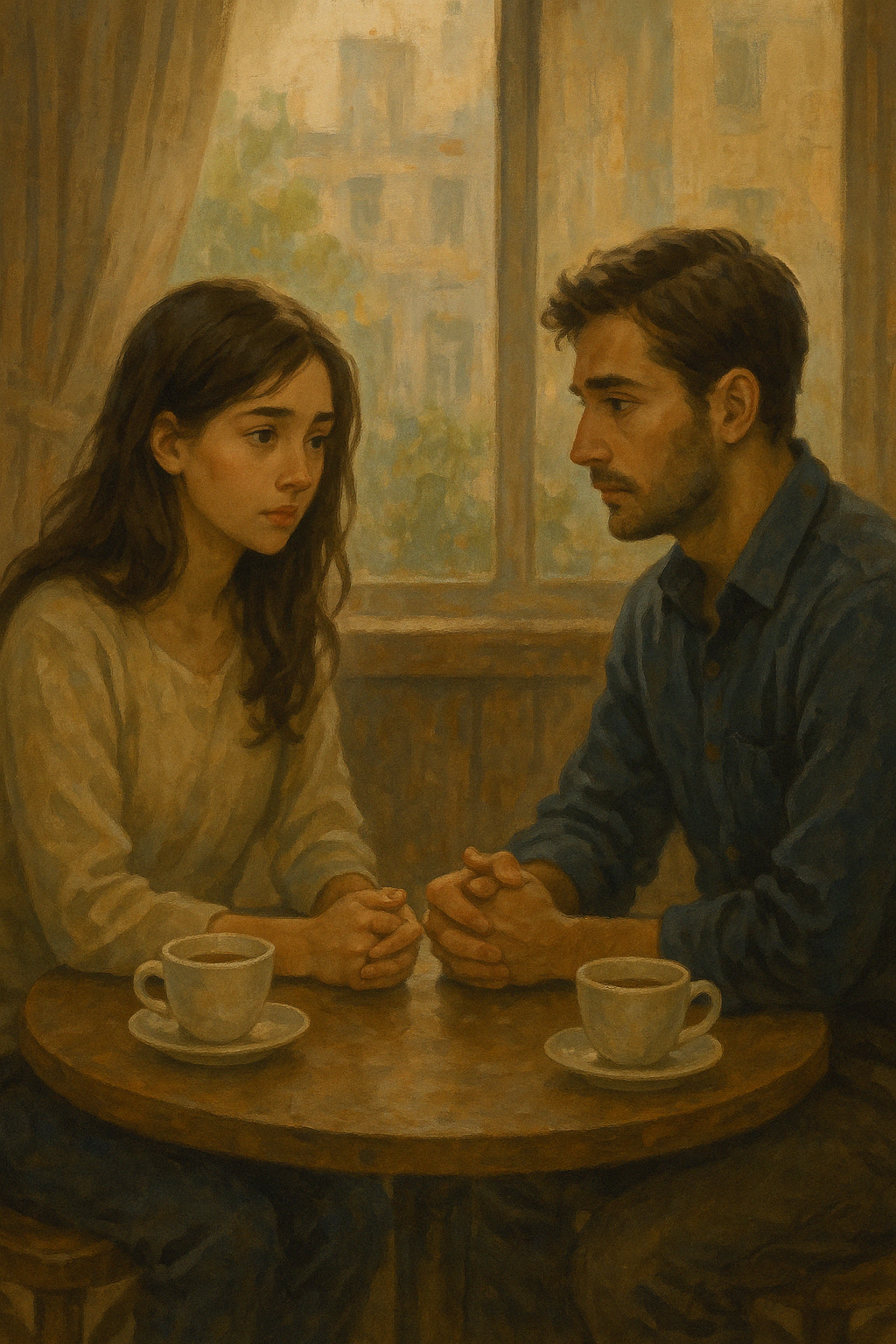
He sat. She sat. And for a long while, neither of them spoke. The tea had gone cold. The rain outside had stopped. All that remained was the stillness, and the sense that something had shifted between them.
She studied him—the way his fingers fidgeted with the edge of the bag, the curve of his shoulders still bearing the weight of loss.
“Thank you,” she said, finally.
He looked up. “For what?”
“For remembering me. Even if I don’t always know how to be remembered.”
Raiyan didn’t respond right away. Instead, he reached into the bag, pulled out the croissant, and broke it in half.
He offered her a piece.
And she took it.
In silence, they shared something small. Something gentle.
Something that didn’t demand answers just yet.
After a while, Elara spoke again. “Do you… ever wonder what it would be like if things had happened differently?”
Raiyan looked down at his hands. “Every day.”
There was a pause—full, but not heavy.
“I think about the wedding sometimes,” he continued. “About the vows. The way you would’ve looked walking toward me.” He paused. “And then I remember that you never got to. And I don’t know how to carry that memory—because it never became one.”
Elara’s throat tightened. She wanted to say she understood. That in her own way, she too had a wedding that never happened. A future that had paused too soon.
But instead, she reached for the teapot, refilled his cup, and said quietly, “Maybe it’s enough to walk beside each other now.”
He met her eyes. A flicker of something passed between them—not recognition, not certainty. Just warmth.
She walked him to the door after they finished their tea. He lingered again, as he had the night before.
“Goodnight, Mira,” he said, more gently this time.
“Goodnight, Raiyan.”
She closed the door softly behind him.
Across the street, Raiyan stood still beneath the dim porch light of the bakery, unsure why his feet hadn’t yet moved.
He hadn’t meant to go there that morning. Hadn’t planned on knocking on her door.
But something about the way she had looked at him the night before—the way her voice trembled when she said his name—had haunted him into the morning. It was both familiar and strange, like hearing an old melody played in a different key.
He had walked to the bakery on instinct. The same one she used to visit every Sunday morning, always choosing the same pastry: almond croissant, slightly warmed.
When the owner asked, “For Mira?”, he had nodded. And for a brief moment, it had felt like nothing had changed.
But everything had.
And he didn’t know whether to be grateful… or afraid.
The weight of her presence clung to him as he walked away from the door. Not just because she looked like Mira—so achingly similar it hurt to breathe—but because she didn’t act the same. Not always. Her smile was softer. Her gaze lingered longer, but in a different way. Curious, not confident. Observant, not knowing.
She moved like someone rediscovering the world.
Raiyan couldn’t explain it. And maybe he didn’t want to. Maybe explaining it would collapse the fragile spell of it all.
He remembered how she had touched the rim of her teacup earlier, as if committing its texture to memory. The way she had hesitated before accepting the croissant, like it was an offering from a stranger, not a habit from a shared past.
And yet—she was still her. Wasn’t she?
He sighed, stuffing his hands into his coat pockets as he turned the corner.
Maybe grief had fractured something in him. Maybe love had blurred the edges of logic. Or maybe—just maybe—this was what a second chance looked like: imperfect, quiet, and nothing like he imagined.
But it was hers.
And he would take every moment he could get.
Even if, deep down, he didn’t know who exactly he was falling in love with now.
Elara stood by the door long after it had closed. Her fingers lingered on the knob, as though it still held the warmth of his parting touch.
The apartment was quiet again, but not empty. His presence still lived in the air—in the faint scent of rain clinging to his coat, in the soft echo of his voice when he said her name.
Her borrowed heart beat unevenly.
She walked back into the kitchen, placed the untouched half of the croissant back in its bag, and sat at the table. Her fingers curled gently around the cup of now-cold tea, and her thoughts began to stir.
What was she doing?
Every instinct told her to keep her distance. To draw lines. To leave quietly when the hundredth day came and let the memories dissolve.
But it wasn’t that simple anymore.
She had seen the way he looked at her. Not just with longing, but with something gentler. Something more afraid. As if he, too, feared what he was beginning to feel.
And worst of all—she hadn’t pulled away.
A part of her wanted to believe she could give him what he needed. That she could carry Mira’s memories with grace, that she could soothe his ache with kindness. But another part, buried deeper, whispered of something even more dangerous.
That maybe, just maybe, she was beginning to want something for herself too.
She stood and wandered back into the living room, her arms crossed around her waist as if holding herself together. A photograph on the wall caught her attention—Mira and Raiyan beneath a tree in full bloom, her head on his shoulder, his hand in hers. The smiles were unguarded. Honest. It hurt to look at, but she couldn’t look away.
Was she intruding on a memory that wasn’t hers to enter?
Her fingertips brushed the edge of the frame. She imagined what Mira would say if she were watching. If she were standing in the doorway, arms folded, watching another woman live pieces of her unfinished life.
“I didn’t ask for this,” Elara whispered. “But I’ll try not to break what you left behind.”
She stepped back. In the stillness, a strange sense of guilt bloomed in her chest—not because she was falling for Raiyan, but because she didn’t know if she was allowed to.
She had a hundred days.
And already, she was afraid of day one hundred.
Not because she would vanish.
But because she wasn’t sure how he would survive losing Mira all over again.
Or how she would survive leaving him.
She turned off the lights and stood at the window, watching the last streaks of dusk fade into the quiet hum of night. Down on the street, a couple walked hand in hand beneath a shared umbrella, laughing about something she would never hear.
Elara pressed her palm lightly to the glass. She wasn’t sure who she was anymore—only that each day, she was becoming someone new, shaped by borrowed grief and unexpected tenderness.
Tomorrow would come. Another morning. Another layer of this strange life.
And maybe—just maybe—it would bring a moment not meant for healing or remembering, but simply for living.